
Digital Product Passports: from regulatory requirement to strategic opportunity
The Digital Product Passport: Beyond Compliance
In recent years, the concept of the Digital Product Passport (DPP) has evolved from an emerging idea into a central pillar of the European regulatory landscape. Driven by the Ecodesign for Sustainable Products Regulation (ESPR), the DPP is set to transform how information has to be disclosed and consequently how products are designed, produced, used, and recovered.
However, approaching it purely as a compliance exercise means overlooking much of its potential. The DPP is not just a data repository that fosters transparency. It is a communication tool, a direct interface with the end user that optimizes business intelligence, and a facilitator of circular business models.
Where regulation stands today
The ESPR framework was published in June 2024, establishing the legal architecture for the DPP. The regulation sets out the essential requirements — every DPP must be linked to a unique product identifier, carry a physical data carrier (such as a QR code), and store data in open, interoperable formats. The European Commission was required to adopt a first Working Plan by April 2025, prioritising product groups such as textiles and garments, furniture, iron and steel, aluminium, electronics, and tyres, among others.
However, the specific requirements for each product group — what data must be included, at what level of granularity (product model, batch, or individual item), who can access what, and when obligations come into force — will only be defined through delegated acts developed after the Working Plan. In other words, the framework is set, but the precise details of what a compliant DPP must contain for your product category are still being defined. Companies will not have full regulatory certainty until those product-specific delegated acts are published, which will likely take several more years for most categories.
Beyond traceability: a new layer of product interaction
One of the key contributions of the DPP is enhanced traceability across the value chain, enabling access to structured data on materials, production processes, environmental impacts, and certifications.
But its real value emerges when this information is translated into meaningful user experiences. Furthermore, DPPs can even reposition sustainability from a cost center into a value-generating function.
A well-designed DPP can become:
A care and maintenance guide that extends product lifespan
A facilitator for repair, reuse, and recycling
A channel to activate circular services such as repair, take-back and resale
A platform for substantiating sustainability claims
In this sense, the DPP shifts from being a technical document to becoming a dynamic touchpoint between brand and user, and can open up new business opportunities for companies.
The DPP as a communication and engagement tool
In a context where consumer trust is increasingly tied to transparency, the DPP offers a powerful opportunity to communicate with rigor and credibility.
Moving beyond generic narratives, it allows brands to back claims with verifiable data, show the full journey of a product, explain design and material choices, and educate users on more sustainable behaviors.
But the real shift goes further. DPPs have the potential to fundamentally change how brands approach marketing, particularly in sectors like fashion and furniture. Not as a compliance tool with a QR code added at the last minute, but as a direct channel to connect with the customer, attached to the product itself.
That said, DPPs do not automatically generate engagement. Their impact depends on how they are integrated into the customer journey. Brands need to actively surface them, explain their value, and design experiences that make users want to interact with them. Content architecture and user experience design are critical to ensuring that the DPP is not only accessed, but actually used to motivate maintenance, repairs, resale and recycling. Ultimately, this engagement becomes loyalty long after the original transaction and represents a clear differentiating factor compared to the competition.
Turning complexity into opportunity
Implementing a DPP requires coordinating multiple dimensions: data, technology, design, regulation, sustainability, communication and operations.
However, when approached strategically, it can be used to drive business transformation, because improving data quality and consistency is a key part of the process. Having data is fundamental to enabling circular business models, strengthening customer value propositions, and differentiating in an increasingly demanding market.
The data obtained for inclusion in the Digital Product Passport provides the company with a path for continuous improvement, enabling the identification of areas susceptible to optimisation and fostering the implementation of new initiatives.
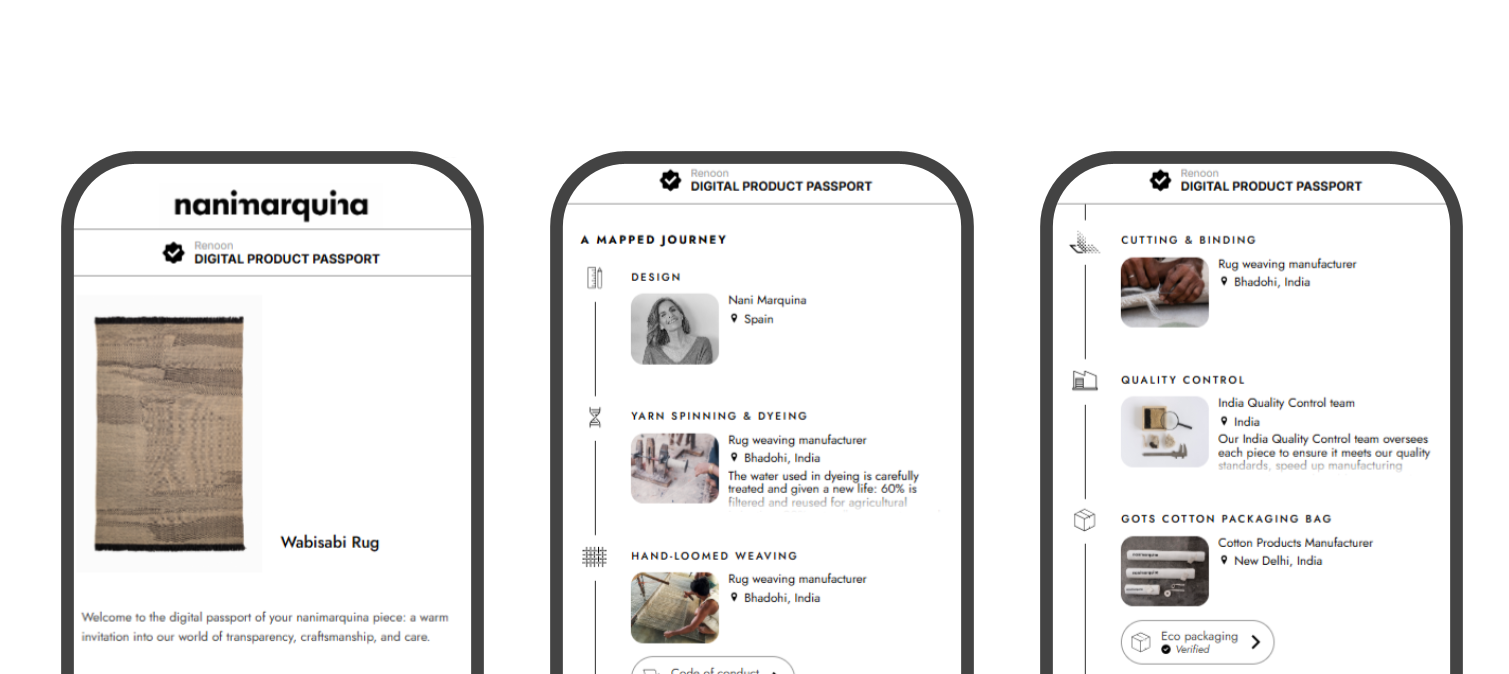
The digital product passport for nanimarquina.
From concept to practice: Long Life Textiles and nanimarquina
Our practical experience with DPPs started in 2023 within the Long Life Textiles research project, in which Digital Product Passports were explored as tools to extend the lifespan of textile products and enable their recovery at the end of their life by applying Industry 4.0 technologies. Back then, we explored how DPPs could fit within nanimarquina’s context, and now it has become a fully implemented system.
For nanimarquina, the passport was conceived not just as an information layer, but as an extension of the product itself.
In 2026, nanimarquina launched the DPP through the full range of products, providing:
Detailed information on materials and manufacturing steps
Access to information on environmental impact
Care and maintenance guidance
Support for end-of-life management
A stronger emotional connection between user and product
This case illustrates how DPPs can be meaningfully integrated into a brand’s value proposition.
At the same time, implementation comes with very tangible operational challenges. Even something as seemingly simple as adding a QR code to a product requires robust systems and quality control processes: ensuring that the correct code is consistently linked to the right product may require an operational change and should therefore be given careful consideration.
Aligning with ESPR: the time to act is now
The rollout of DPPs under the Ecodesign for Sustainable Products Regulation (ESPR) will progressively impact multiple product categories in the coming years.
While specific requirements are still being defined, one thing is clear: implementation takes time.
A proactive approach involves:
Assessing current data availability and quality
Reviewing documentation that supports sustainability claims
Identifying gaps in traceability
Defining a strategy aligned with business and product reality
Waiting until compliance becomes mandatory often leads to rushed processes, suboptimal solutions, and higher costs.
Anticipating regulation, on the other hand, allows companies to embed the DPP strategically across product design, communication, and services.
However, don't feel pressured to do everything at once when you're getting started. Focus instead on taking one step at a time: initiate internal conversations, engage with suppliers, map existing data, identify gaps, and run pilot projects in order to begin building capabilities.
How Nutcreatives can support you
At Nutcreatives, we support companies throughout the entire journey of Digital Product Passport readiness and implementation, combining strategy, design, and execution.
We can help you with:
ESPR / DPP readiness
Assessing your current position and defining a clear roadmap toward compliance and beyond.DPP provider advisory
Identifying and selecting the right technological solutions based on your context and needs.Experience and content design
Crafting the information architecture, narrative, and user experience of your DPP as a communication channel.Implementation project management
Coordinating stakeholders, providers, and project phases.Communication support
Integrating the DPP into your brand strategy and activating its full engagement potential.
The Digital Product Passport is not just a future obligation; it is a present opportunity to redefine the relationship between products, brands, and users.
The question is no longer whether to implement it, but how to turn it into a real source of value.
→ Contact us to start your path toward the Digital Product Passport!